The Ash Girl by Timberlake Wertenbaker
Directed by Brian E.G. Cook
Scenic Design by Brian E.G. Cook. Lighting/Projections by Kade Mendelowitz.
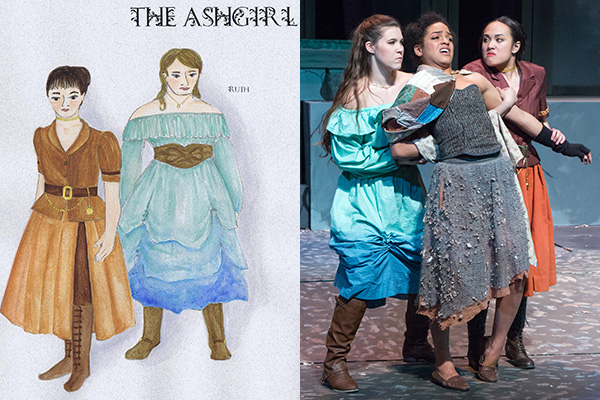
The Ash Girl must find love by overcoming her own demons, represented in the play by animal manifestations of the seven deadly sins. Using the classic fairytale Cinderella, The Ash Girl explores many contemporary issues including depression, psychological abuse and female ideals.
Right: Rendering of Ashie's Stepsisters, pictured torturing the Ash Girl for fun. Photos by K. Mendelowitz. Click here for more images.
An Inspector Calls by J..B Priestley
Directed by Brian E. G. Cook
Scenic Design also by Bethany Marx. Lighting by Adam Gillette.
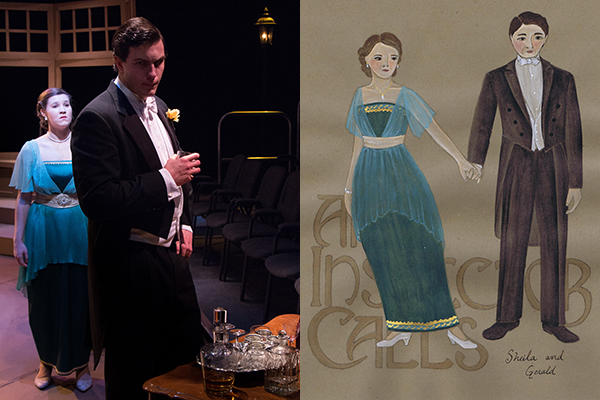
A mysterious inspector appears at the Birling residence and, in an evening, turns their lives upside down. This detective-style British drama set in 1912 comments on the dangers of ignoring the plight of others, and foreshadows the uncertainty of the coming World Wars.
Left: Rendering of Sheila Birling with her finance, Gerald, pictured in a confrontation at the end of Act I. Photos by Kade Mendelowitz. Click here for more images and to see the set design.
Tartuffe by Moliere
Translated by Richard Wilbur. Directed by Brian Cook
Set Design by Brian Cook. Lighting by Adam Gillette
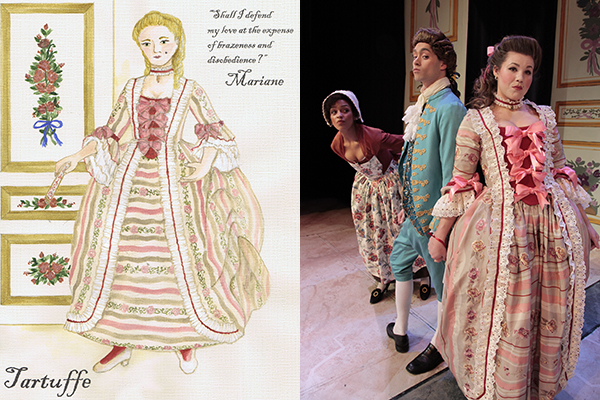
Saucy maids, overdramatic lovers, and one idiotic husband…not to mention history’s most pious con man! Set around 100 years after the play was originally written, this bombastic production of Richard Wilbur’s rhyming translation embraced slapstick, direct address and physical comedy, not to mention a spy pretending to be a maid, and a splendid (fake) moustache.
Right: Rendering of Mariane, Orgon's dutiful daughter, pictured with Valere, her lover and Dorine, her maid. Photos by M. Salganek. Click here for more images.
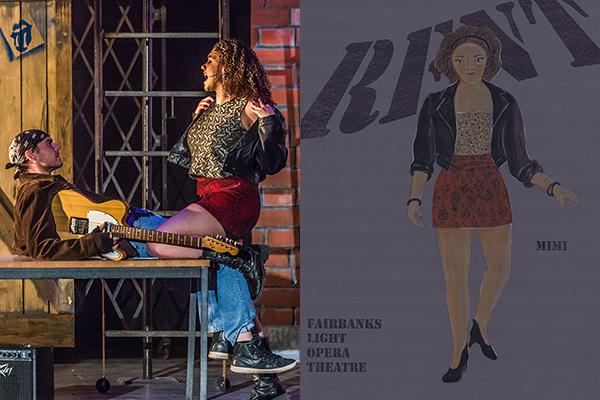
Rent by Jonathan Larson
Directed by Kurt Newman
Set Design by Josh Bennett, Lighting by Deirdre Adams
In this award-winning rock opera set in New York city in the early 90s, a group of friends dealing with poverty and the AIDS epidemic explore what it means to find love and create art in an increasingly disconnected society.
Left: Rendering for Mimi in Act I, pictured with Roger. Photos by Todd Paris. Click here for more images.
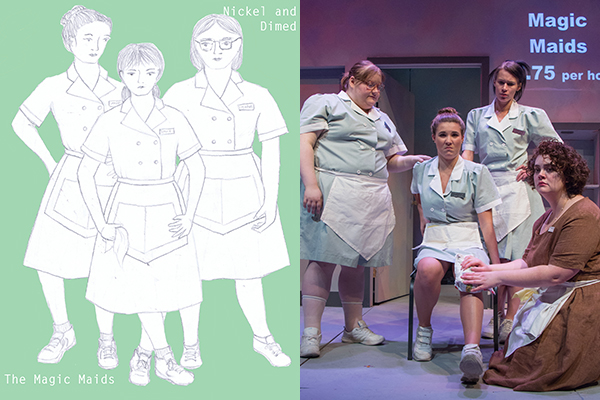
Nickel and Dimed by Joan Holden
Directed by Brian E.G.Cook
Scenic, Lighting, and Sound Design by Kade Mendelowitz
Based on the popular book by Barbara Ehrenreich, Nickel and Dimed is a fast-paced, comical look at the unfortunate circumstances minimum wage workers in America face every day. With 193 costume pieces, 48 different costumed characters, and eight different uniforms with seven different custom name tags, Nickel and Dimed introduces us to the plight of those barely getting by in a plethora of situations.
Right: Sketch of the "Magic Maids" Holly, Marge and Maddy, pictured with Barbara. Photos by K. Mendelowitz. Click here for more images.
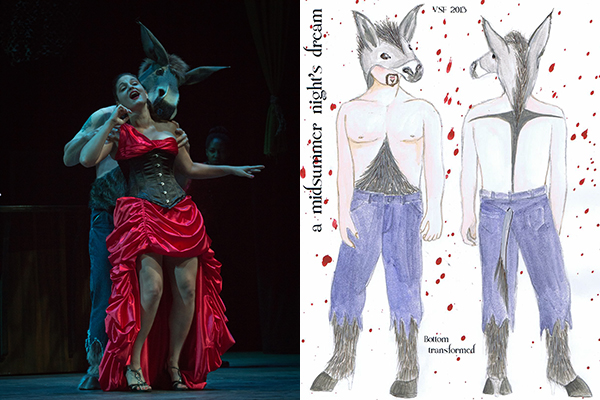
A Midsummer Night's Dream by William Shakespeare
Directed by Mark Lerman
Scenic Design by Jeremy Woodward. Lighting Design by Steve Holliday
This light-hearted, contemporary production was inspired by modern vampire pop culture including Twilight, Buffy the Vampire Slayer and True Blood. Teenage lovers are driven by desperation into the forest where they encounter supernatural beings with their own agendas.
Left: Rendering and production photo of Bottom, transformed, pictured with Titania, Queen of the Fairies. Photos by Steven Koernig. Click here for more images.
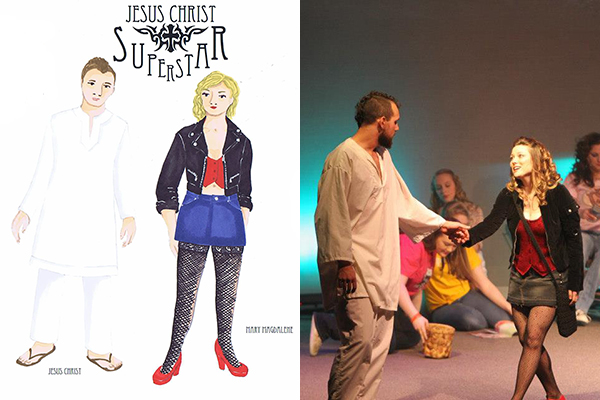
Jesus Christ Superstar by Tim Rice and Andrew Lloyd Webber
Directed by Brian Bennett
Scenic Design by Brian Bennett. Lighting by Rudy Cook.
If modern rock and roll is a metaphor for the life of Jesus, then the apostles are easily cast as band members, roadies and groupies; the "evil mob" as controlling radio executives and Jesus, himself, as the misunderstood artist trying to speak to the world in a language it isn't ready to understand.
Right: Rendering and production photo of Jesus with Mary Magdalene, a one-time prostitute reborn. Photos by Steve Cross. Click here for more images.
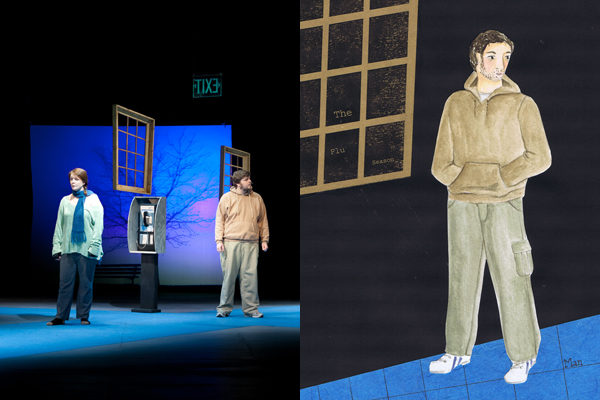
The Flu Season by Will Eno
Directed by Stephan Golux
Scenic Design also by Bethany Marx. Lighting Design by Deirdre Adams
Will Eno comments on the difficulties of writing a play as he tells the bittersweet story of a man and woman who fall in love while confined to a mental institution for the Winter.
Left: Rendering and production photo for the Man, pictured at a payphone in the hall with the Woman. Photos by Kade Mendelowitz. Click here for more images.
The Merchant of Venice by William Shakespeare
Directed by Christopher Owens
Scenic and Lighting Design by Greg Hillmar
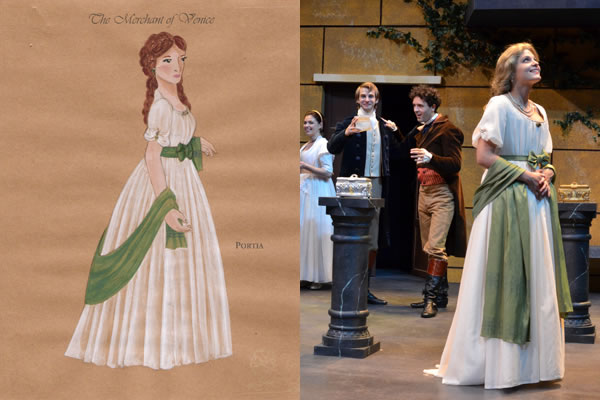
Set in 1795, only two years after the Venetian laws regarding Jewish attire were abolished, this intimate production of the Merchant of Venice focused on the passing of values from the older generation to the younger, and the important role that both justice and mercy play in society.
Right: Rendering and production photo for Portia, pictured with Bassanio, her lover, and Gratiano, his friend. Photos by Geoff Wade. Click here for more images.
The Two Gentlemen of Verona by William Shakespeare
Directed by Steven Breese
Scenic and Lighting Design by Greg Hillmar
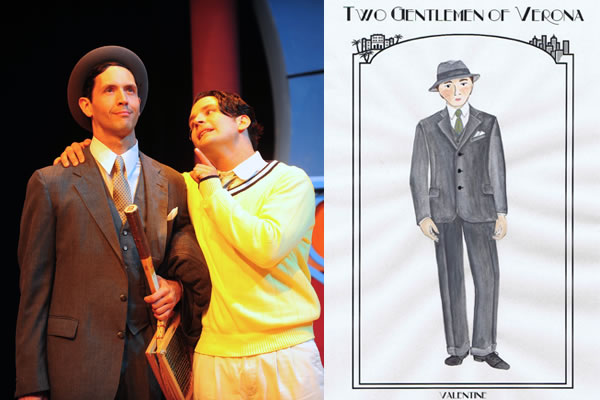
Two friends from the 1926 beach resort town of Verona travel to the big city of Milan, only to find themselves in love with the same girl in this roaringly fun version of one of Shakespeare's earliest plays. Twenties bathing suits, flappers, gangsters and bootleggers, not to mention wacky, strobe-light, silent flim interludes, provided a quick-paced, hysterical environment for this popular play.
Left: Rendering for Valentine, pictured with his best friend Proteus. Photos byRobert Boag. Click here for more images.
All in the Timing by David Ives
Designs for "The Universal Language," "Philip Glass Buys a Loaf of Bread," "The Philadephia" and "Variations on the Death of Trotsky"
Directed by Stephan Golux. Scenic Design by Adam Gillette. Lighting Design by Tom Creek. Costumes for "Sure Thing" and "Words, Words, Words" by Ari Wattum
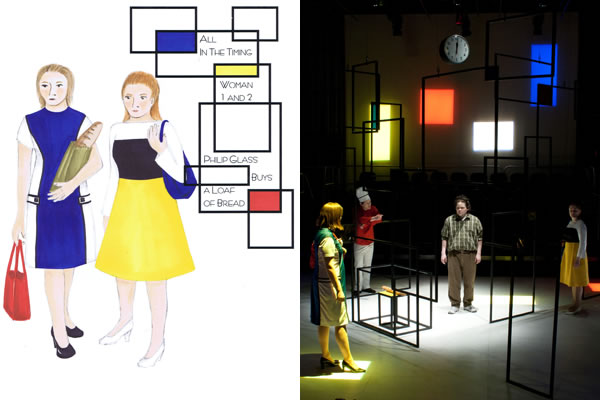
David Ives brilliantly jokes about life, language and the human spirit in this collection of short plays. The design for this production was inspired by the color-block paintings of Mondrian.
Right: Rendering and production photo for the two women in "Philip Glass Buys a Loaf of Bread." Photo by K. Mendelowitz. Click here for more images.
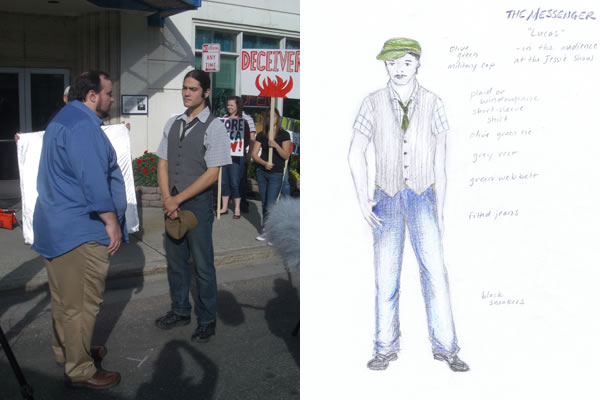
The Messenger: A Film by Kade Mendelowitz
Directed by Kade Mendelowitz
Directory of Photography: Maya Salganek. Scenery: Carl Sage. Lighting: Deirdre Adams
In this feature length film from writer/director Kade Mendelowitz, Jessie (Carrie Baker), a woman torn from her faith by a tragic and life-changing incident, finds renewal from the unexpected visit of an angel with an important message.
Left: Sketch for Lucas, a protestor, pictured on location with Jeremy, the protest leader. Photo by B. Marx. More images available upon request.
View the trailer here!
The Winter's Tale by William Shakespeare
Directed by Stephan Golux
Scenic and Lighting Design by Rhi Johnson
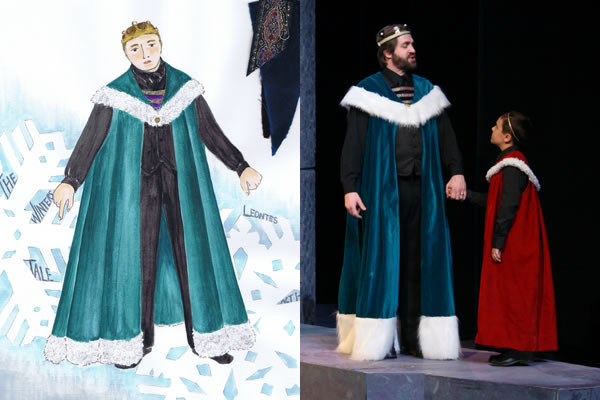
The Winter's Tale can be described as two plays, separated by 16 years and woven together in the final act. In this production, dark jewel tones and heavy fabrics define the tragic world of Sicilia, while light colors and bright floral fabrics highlight the coming of Spring in Bohemia.
Right: Rendering and production photo for King Leontes of Sicilia. Pictured with his son, Mamillius. Photo by K. Mendelowitz. Click here for more images.
Click here to see the Bear!
Can Can Plays the Bay at Nice: A Collection of One-Acts
Can Can by Romulus Linney, Play by Samuel Beckett, The Bay at Nice by David Hare
Directed by Stephan Golux. Scenic Design by Kade Mendelowitz. Lighting by Rhi Johnson
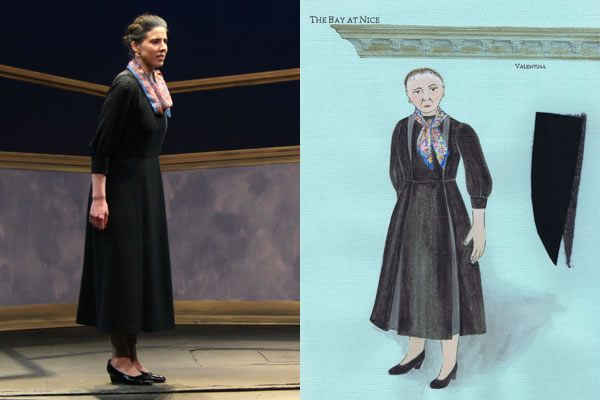
From communist Russia to a country diner, love takes all forms in this collection of plays about relationships and the durability of the human spirit. Bright colors and haunting makeup support the stylized texts of Can Can and Play (respectively), while realistic clothing reflects the gritty world of The Bay at Nice.
Left: Rendering and production photo of Valentina in The Bay at Nice. Click here for more images.
Into the Woods by Stephen Sondheim and James Lapine
Directed by Gwen Brazier
Scenic Design by Tom Creek. Lighting by Kelly Stables
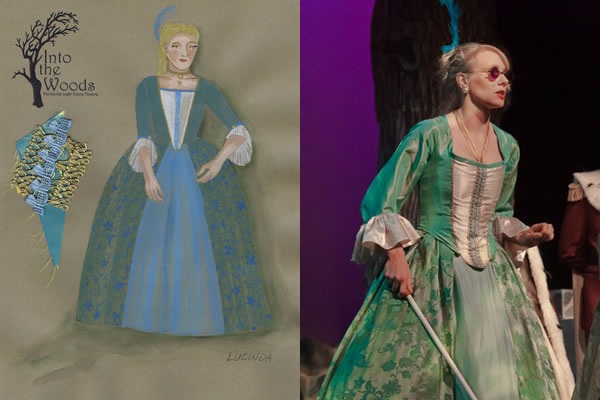
Gut-wrenching humor and heartbreaking tragedy combine in this famous musical by Stephen Sondheim. Iconic images from well-known fairytales combine with unpredictable circumstances to create ironic and unexpectedly human characters.
Right: Rendering and production photo for Lucinda, an ugly stepsister. More images available upon request.
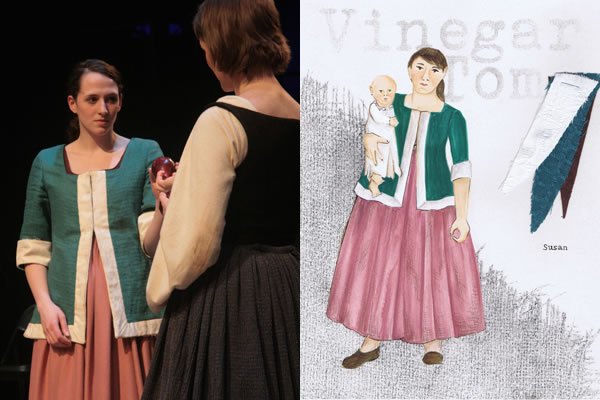
Vinegar Tom by Caryl Churchill
Directed by Stephan Golux
Lighting Design by Adam Gillette. Props by Rhi Johnson
Vinegar Tom alternates dramatic scenes about a 17th Century witch hunt with modern songs commenting on the treatment of women through the ages. Because the production was in-the-round, costumes and props provided most of the context and character information for the audience.
Left: Rendering and production photo for Susan, a young mother. Photo by S. Golux. Click here for more images.
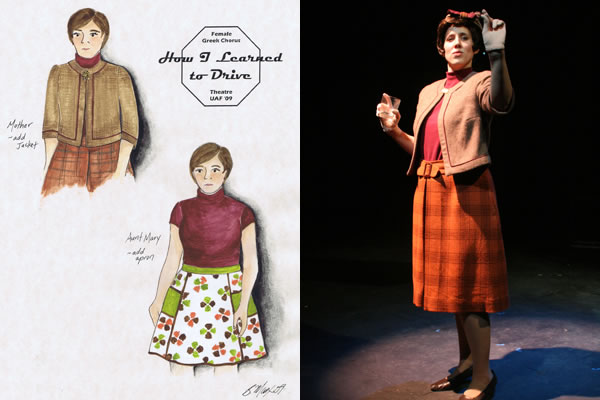
How I Learned to Drive by Paula Vogel
Directed by Carrie Baker
Scenic and Lighting Design by Kade Mendelowitz
How I Learned to Drive may be an unhappy, even tragic story about child abuse and incest, but despite that it is remarkably funny. While the two main characters remain themselves throughout, a small chorus provide the rest of the cast, playing awkward teenagers, comical family members and other bit parts. Flexible base costumes and added pieces are necessary to differentiate characters and tell the story.
Right: Rendering and production photo for the Female Greek Chorus as Mother, an expert on drinking. Photo by K. Mendelowitz. More images available upon request.
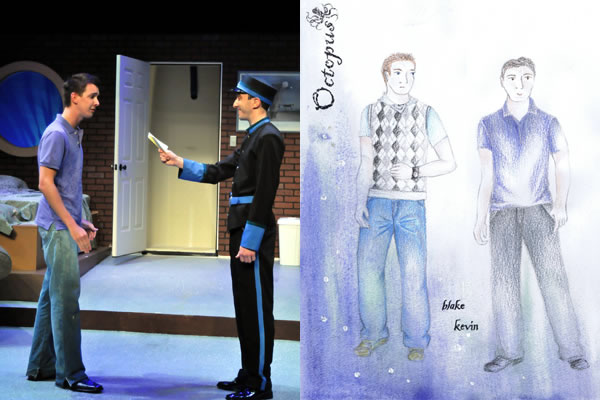
Octopus by Steven Yockey
Directed by Bryan Fonseca
Scenic Design by James Gross. Lighting by Laura Glover
In this careful combination of reality and the abstract, Yockey explores what it means to be living with HIV in today's world. After a foursome leads to an unexpected health scare, a telegraph boy appears, soaking wet from the bottom of the ocean, delivering cryptic messages and raising questions about what it really means to love someone unconditionally.
Left: Rendering of Kevin and his boyfriend Blake. Production photo of Kevin with the cheerfully surreal telegraph boy. More images available upon request.
The Zippers of Zoomerville: A Mini Mockeretta by Jack O'Hara and Tim Brickley
Directed by Jack O'Hara
Scenic Design by James Gross. Lighting by Laura Glover
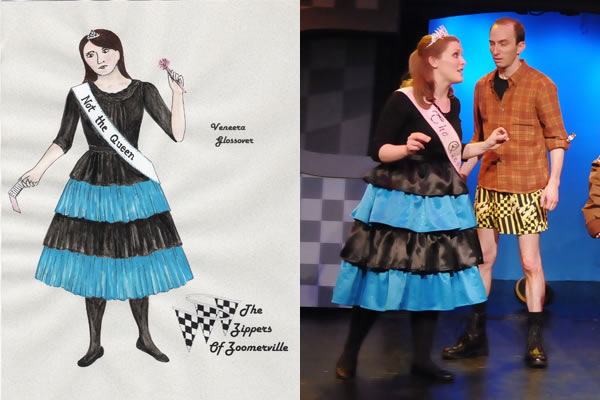
A parody based on the famous Indy500, The Zippers of Zoomerville is a wacky, 'punny,' slapstick with music inspired by Gilbert and Sullivan. Six actors switch from one character to the next in a matter seconds, requiring simple, identifiable costume pieces with a humorous flare.
Right: Rendering and production photo for Veneera Glossover, a perpetual runner up, pictured with John Hoosier Lordyboy Jr., a rookie driver. Photo by B. Marx. Click here for more images.
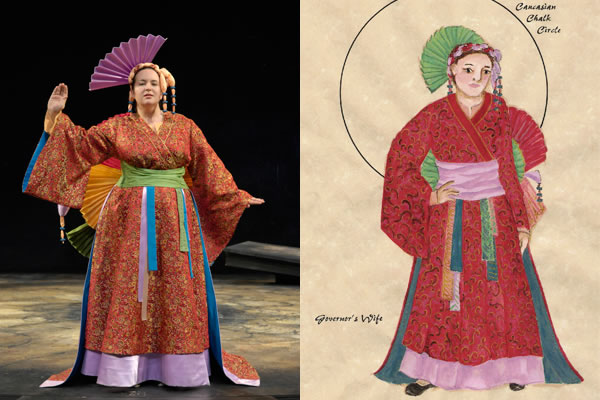
The Caucasian Chalk Circle by Bertolt Brecht
Directed by Keith Langsdale
Scenic Design by Sean Cote, Sam Laird and Rob Christiansen. Lighting by Robert Strano
Eclectic is the only work that can describe this uncommon production, combining Asian inspired costumes; Russian and American folk music; scant, post-disaster sets, stylized fight choreography and puppets. These costumes emphasize the divide between the social classes through style and use of color.
Left: Rendering and production photo for The Governor's Wife. Photo by Jon Crispin. Click here for more images.
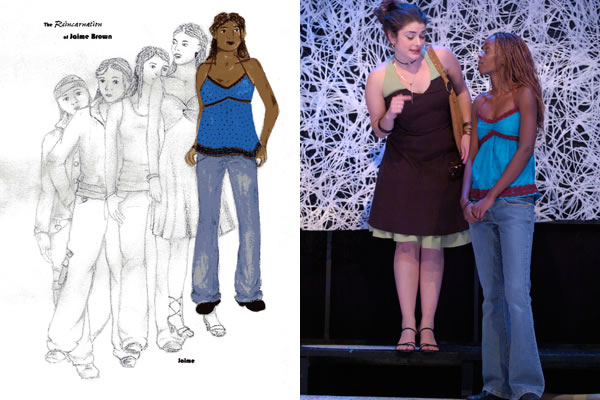
The Reincarnation of Jaime Brown by Lynne Alvarez
Directed by Sheila Siragusa
Scenic Design by Sean Cote, Sam Laird and Rob Christiansen. Lighting by Brenda Cortina
In this play about learning to live life to the fullest, dark, layered clothing transitions into bright colors and flowing lines as characters who are defensive and guarded become trusting and open.
Right: Multi-image rendering and production photo for Jaime, the possible reincarnation of a wealthy man's son. Photo by Jon Crispin. Click here for more images.
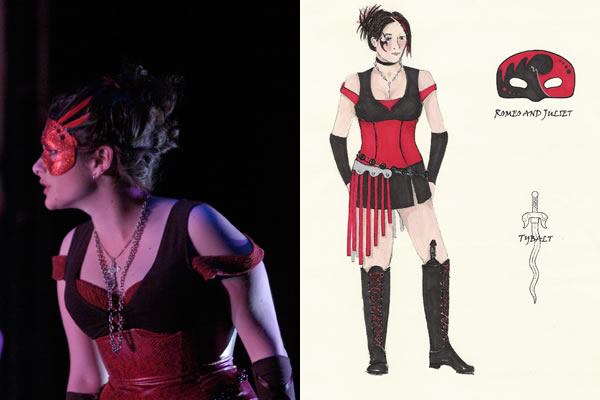
Romeo and Juliet by William Shakespeare
Directed by Jeannie-Marie Brown
Lighting by Penny Remsen
This production of Romeo and Juliet, intended for local high schoolers, took its inspiration in both direction and design from popular video games including Final Fantasy and Fire Emblem: Path of Radiance. Techno music, dance choreographed fight scenes, cross-gender casting and oversized, stylized weapons brought the play from the Renaissance into the world of fantasy.
Left: Rendering and production photo for Tybalt. Photo by Jon Crispin. Click here for more images.
Gum by Karen Hartman
Directed by Maryann Lombardi
Scenic Design by Sean Cote. Lighting by Robert Strano
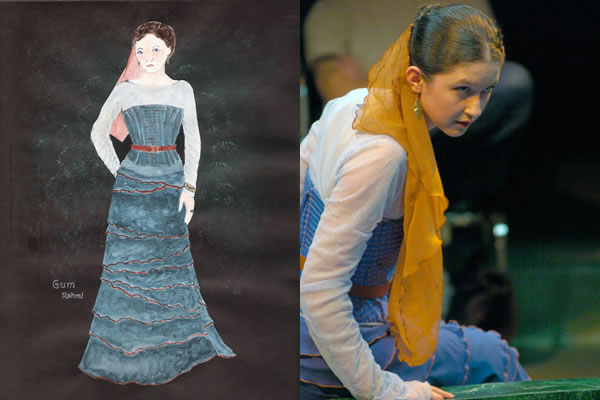
Set in a fantastical world somewhere in the Middle East and produced in a controversial setting (for an audience who opposed the play before seeing it), Gum's challenging design combined organic and beautiful elements with restraint, rebellion, and death. The two young women in the play represent flowers in their father's garden, but the beautiful clothing restricts their movement, just as the garden walls hold them in.
Right: Rendering and production photo for Rhami, the older sister. Photo by Jon Crispin. Click here for more images.